


While most of audit leaders report some level of AI use (93 percent), only 38 percent have an AI strategy, according to a survey by Gartner, a business and technology insights company.
The poll of 743 audit professionals, taken recently, revealed that generative AI (GenAI) use cases in internal audit center on isolated tasks, such as engagement pre-planning, drafting audit issues, and reviewing drafts (see Table 1). Less than a third are using AI for audit testing (30 percent), and only a small fraction are applying AI to broader departmental activities such as quality assurance reviews (12 percent).
“Audit’s current use of GenAI concentrates less on strategic audit use cases and more on moderate productivity improvements,” said James Bourke, Director Analyst in Gartner’s Risk & Audit Practice. “Therefore, although AI adoption rates are high in audit functions, it is not generally resulting in transformation of audit processes or delivery of better strategic insights.”
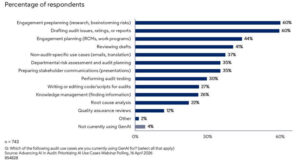
AI is also widely used in the reporting phase, with 60 percent of respondents using the technology to draft internal audit issues, ratings, or reports, 41 percent using it to review drafts, and 35 percent using it to prepare stakeholder communications such as presentations.
Other AI use cases, while emerging, are less prevalent. Thirty-seven percent of audit leaders and auditors use AI for general productivity tasks such as email writing or translation. At the departmental level, 35 percent use AI for risk assessment and audit planning, 26 percent for knowledge management, and 12 percent for quality assurance reviews.
Gartner analysts say that while AI adoption in audit is high, many teams are still struggling to clearly define and communicate the value it delivers. This means taking a deliberate approach that links AI initiatives to audit quality, consistency and risk insights. They said audit leaders should not just point to adoption levels or productivity gains as a measure of success.
“Focusing narrowly on productivity or adoption metrics risks underrepresenting and even missing out on AI’s potentially broader impact on audit outcomes and decision-making,” said Bourke. 